HISTORY OF BECKLEY AND RALEIGH COUNTY
Page 2 - Various Articles
Letter to the Editor (1916)
The following letter was written to the Raleigh Herald in 1916 by G.
T. McClure.
I heard a man say the other day that nothing surprised him these times.
I hope that this letter will not surprise you. I will be 90 years old
the fourteenth day of January, 1917. I am staying at E. M. Senter’s my
son-in-law.
I am lonesome this morning; there being none of my age living about
here. They are all gone. The last one was Capt. James A. Cook. I miss
him much. My mind runs back to the old times in 1844. We moved to West
Virginia with John McClure and family. We stopped at what was called
"Wildwood," a mile from the forks of the road, where Raleigh Court
House now stands, where General Beckley lived at that time -- his wife
being dead. He and his two boys -- John and Neville -- boarded with us
for some time. We built him a saw mill and gristmill in Piney River.
Think they are standing there now, about one and one-half miles from
his home. At that time there was a mail route from Logan Court House to
Pack’s Ferry at the mouth of Bluestone. Every two weeks the trip was
made. John Canterbury was the carrier. The first house on the road to
Pack’s Ferry was William Prince, the next Richard McVey, the next
Clarkson Prince, then John Pittman, then Henry Hull, then S. A. White
with Moses Scott and Samuel Pack near Jumping Branch, on the road that
leads to Logan Court House. Edward Prince next, then Lewis Stover, John
Bailey, Joseph Harper, Daniel Shumate, where George Callaway now lives,
next Lucien Davis and George Snuffer at the foot of Guyan Mountain.
These are some of the early settlers of the Marsh Fork of Coal
River: James Bryson, Hugh Davis, John Payton on Sand Lick, Rev. Matthew
Ellison, Tilden Phipps.
We come back to White Stick: George Bailey, Spaniel Bailey, Henry
Smith at the mouth of Piney, then up the ridge we come to Joseph
Carper, John Redden, Robert Scott, James Scott.
General Beckley had large land interests in and around his home. He
went to work for a new county and never stopped till he was successful.
The new county was named Raleigh and the county seat where it now
stands.
The first settlers of Beckley were James Cole, Henry Stanger, Jesse
Dean, Edward Prince, Henry L. Gillispie, John McCreery, Rev. Matthew
Ellison, John McClure, Daniel Shumate.
Earl Epperly and I built the first house in Beckley. It was built
with white pine logs for James Cole. It stands there yet, but has been
remodeled. It is the house that Judge James H. McGinnis died in, eight
or nine years ago.
If there is any one of the persons named in this letter living I
would like to hear from them. I am enjoying good health—eat three
meals a day, but have no teeth.
Mrs. Campbell Tells Of Early History of City (1930)
Local Lady Gives Her Impressions Before D. A. R. Meeting
of
Beckley as it Was Sixty Years Ago
This article appeared in the Sunday Register in January 1930.
The Captain James Allen Chapter of the Daughters of the American
Revolution met with Mrs. A. Bailey, of Mabscott, last Tuesday. The
ladies were entertained with a one o’clock luncheon of lovely
appointments, the two tables being decorated with maidenhair ferns and
yellow roses. After the luncheon, the regular program followed with Mrs.
Bettie D. Campbell giving a most interesting paper on “Beckley
Sixty Years Ago.” Mrs. Campbell said in part:
If you will pardon me I shall have to refer probably more than once
to my grandfather, General Alfred Beckley, as it was he who in 1837
resigned his commission in the United States Army and came to what is
now Raleigh county to look after a large boundary of wild lands
inherited from his father.
He immediately set about establishing a home, calling it
“Wildwood,” a name most appropriate. At that early day all
this section of the country for miles around was a howling wilderness,
the dense forests being inhabited by all kinds of wild game, both large
and small, such as bears, panthers, wolves, deer, and all kinds of
birds. I have often heard my grandfather relate how the wolves or
panthers would roam around, often coming very near the house, sending
forth weird screams in the darkness of the night. Imagine the effect on
people of today!
The population at that time was very scattered, the nearest neighbors
being from four to six miles apart. The distance from Wildwood to
Vandalia, now Fayetteville, on the north, was 26 miles, with five
families living in all that distance. And on the south to Packs Ferry on
New River was 24 miles with but four families living on the route.
This section for many years made slow advancement both in development
and population, no one ever dreaming of the abundance of wealth lying
dormant under the densely wooded hills undisturbed by man.
However, the few residents living in the section deemed it necessary
to establish a county seat, where the few trivial matters that arose
from time to time could be adjusted according to law and justice. Hence
my grandfather donated the site and a very unostentatious court house
and jail were built, the jail being made of hewn logs with very little
protection against jail breaks. Not long afterward, a small frame church
was erected, which was later used by the Federal Army for a commissary.
Besides the above mentioned buildings, two small stores and a
blacksmith shop constituted the village. No lights, fences, nor walks,
save the beaten paths made by the few pedestrians, had been built.
The first school house was erected on a site just back of the residence
of Judge W. H. McGinnis, it being the second school in the village. A little
wandering Englishman named Johnson was employed to teach a three months school.
A few years later, several families came and established homes here.
Among the first were Judge Harry L. Gillespie, living where the O’Dell
house now stands; Joseph Hanna, occupying a small cottage where the Rose
Funeral Home now stands; John Rogers, living where the Lilly Music Store is now
located; Mrs. Martha Davis (or Grandma Davis as she was lovingly called)
occupied a quaint little cottage on what is now Main street; Edwin Prince,
living on the site now owned by the Beaver Coal company and occupied by
William MacTaggart; the Mathew Ellison home was located on the present
site of the Beckley Drug company store; Judge James H. McGinnis, living
where the Central school now stands; and last but most dear to my memory
my father’s home nestled among a grove of stately oaks, now the vacant
lot adjoining the home of Hon. Joe L. Smith. These with possibly ten or twelve
other families completed the entire population.
At that time only two streets bore names. They were Neville and
Heber. North and South Kanawha streets were called the James River and
Kanawha Turnpike, and what is now lovely Harper Road was then the Logan
Turnpike.
Development still for many years seemed scarcely noticeable, the
little village remaining far behind many nearby towns. However, in the
spring of 1900 when it became known that the Logan M. Bullitt interests
had acquired a large boundary of coal lands in the county, business
began to pick up. Real estate began to move and everything seemed to
awaken from its lethargy.
From that time to the present day Beckley has not ceased to keep pace
with the times. So let us hope and trust that we may continue the
forward march until our fair city has arisen from an obscure village
among the mountains to a fair city of which we may be justly proud to
claim as our abiding place.
Thomas Walker Led Exploration
Party in 1750 (1950)
This article appeared in the Beckley Post-Herald on Aug. 26, 1950.
Other sources dispute the claim that Walker was the first white man
to arrive in what is now Raleigh County. Thanks to Charlet A. Schaule
for providing this article.
The first white man to set foot in what is now Raleigh County was Dr.
Thomas Walker, leader of an exploration party which "discovered" the
section in 1750.
Dr. Walker, a surgeon and surveyor, was employed by the Loyal Land
Company to survey the region which now includes parts of Western
Virginia and Kentucky. The Loyal company had received a grant from
the British Crown for 800,000 acres north of the dividing line between
North Carolina and Virginia.
In the spring, 1750, Dr. Walker and five companions set out from his
home near Charlottesville, Va., on an expedition to locate eligible
parcels of land to be surveyed by his firm. He went through Southwest
Virginia into upper Tennessee, then into Kentucky, discovering an
naming the Cumberland Gap and Cumberland River.
He kept a journal of his trip, which has been preserved and published.
He followed the Cumberland, then left the river and took a
northeasterly course through Eastern Kentucky, crossing Tug River into
West Virginia at Naugatuck, crossed the Guyan at the mouth of Island
Creek where the city of Logan now stands, and after crossing the head
forks of Little Coal River, reached Marsh Fork of Big Coal River at
the mouth of Hazy, the present site of Edwight.
He followed Marsh Fork to the neighborhood of Eccles, passed through
the present site of Beckley, crossed Piney River back and south of
Pinecrest Sanitarium, crossed Glade Creek back and east of Crow, and
then went over White Oak Mountain on the present Summers County line
and down Madam’s Creek to Hinton.
Dr. Walker, who entered Kentucky 13 years before famed Daniel Boone
made his memorable journey, was a well-educated Virginian for his day.
He was a planter as well as a doctor and surveyor and was born in
Gloucester, Va., in 1715. He was schooled at William and Mary College
and then became a physician at Fredericksburg.
He served in Braddock’s Army under the command of General Washington
as commissary general and was commissioned on behalf of the state of
Virginia to deal with the Six Nations Indians at Fort Stanwix, N. Y.
in 1768.
He was also named commissioner to deal with the Indians at Fort Pitt
(Pittsburgh) in 1777.
Toward the close of his life, he acquired a large estate by a
favorable marriage.
His son, John Walker, served with distinction on General Washington’s
staff during the Revolution. Dr. Walker died in 1794.
For a few months in 1790, he served as a United States Senator.
City’s Oldest Native Daughter Recalls
Early Days in Beckley (1950)
 This article appeared in the Beckley Post-Herald on Aug. 26, 1950.
Thanks to Charlet A. Schaule for providing the article.
This article appeared in the Beckley Post-Herald on Aug. 26, 1950.
Thanks to Charlet A. Schaule for providing the article.
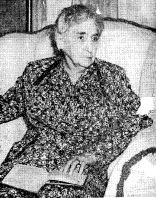
Beckley’s oldest native daughter sat on the cool broad porch of her
spacious 55-year-old home one hot afternoon last June and vividly
recalled the olden days when the city was just a sleepy little town
of a few inhabitants.
She was Mrs. Betty Beckley Campbell, granddaughter of the father of
Beckley and Raleigh County: General Alfred Beckley.
Approaching 82 but still keen of mind, Mrs. Campbell recalled
incidents in the life of the city as she had observed them for the
past 55 years from her West Neville Street home.
Mrs. Campbell, who was born in Beckley in 1868, said "I've only lived
in two houses in Beckley. I was born where the post office is now,
but moved just after my marriage, to this house, which we built 55
years ago."
Her father, John Beckley, purchased the home she was born in from
Capt. Stephen Adams, local attorney who led a Raleigh County company
during the Civil War.
"I still have a wardrobe and bed that my father bought from Capt.
Adams when he got the house, and they're really fine pieces of
furniture," she remarked. "Father got both pieces for only $40,
which is an amazingly low price compared to what they would cost
today."
Mrs. Campbell said the home she and her husband built was located
just above the site of two old springs.
"One was a sulphur spring and the other a fresh one, and at one time
this was called the 'watering place' of Beckley because everyone used
to bring horses to water at the fresh spring."
Mrs. Campbell recalled that when she was a young lady there were no
houses below Rose Funeral Home on that side of the street and none
below the Beckley Theater on the other side.
Judge Henry Gillaspie, she recalled, lived where the funeral home is
today, and Joe Hanna had a cabinet shop where the theater is.
Judge Gillaspie was a slave holder during the Civil War and is
credited with influencing many Raleigh Countians to join the Southern
cause.
"There were few hotels and no restaurants in Beckley when I was a
girl and for some reason the country people didn't like to sleep or
eat at the hotels," she recounted. "I remember when my father was
court clerk he used to bring four or five people home with him every
day.
"He never told my mother whether he would have guests, but she was a
good cook and always had enough just in case."
Recalling the pioneer days of the county, Mrs. Campbell pointed out
that before the railroads came and the coal mines were opened the
county was rather poor.
"The land wasn't too good and most people had a hard time making a
living," she said, adding, however, that the railroads changed all
that.
"Of course the new railroad was very exciting, but I believe the most
excitement I ever saw here was when the first car came to Beckley,"
Mrs. Campbell recalled. "Two of my children came running into the
house and said: 'Mama! Mama! We just saw a buggy without any
horses.'"
She said a man at Blue Jay owned the vehicle, which was soon followed
by those of Dr. E. L. Ellison and George Blair.
Asked whether she remembered much about her grandfather, General
Beckley, she said that she knew him quite well.
"He was a rather small thin man who was good-natured but of a serious
turn of mind. In his later years he read the Bible quite a bit and
was somewhat of a Bible scholar and even did some preaching.
"He was a Methodist and used to travel to various churches to preach,
always riding his horse, a practice which he followed until about two
years before his death at the age of 88."
The General was very tolerant in religious matters, she said,
especially toward Catholics.
"During the Civil War," the General’s granddaughter said, "My
grandfather was a Union prisoner for some time at Camp Chase, Ohio.
Once, when he was sick, a Catholic family took care of him and they
were so nice to him that he always thought kindly of Catholics after
that."
Raleigh County Has History Full of Incidents
Both Funny and Serious (1950)
 This article appeared in 560 News, the monthly
magazine published by WJLS Radio Station in Beckley, in September
1950. 1950 was the centennial year of Raleigh County.
This article appeared in 560 News, the monthly
magazine published by WJLS Radio Station in Beckley, in September
1950. 1950 was the centennial year of Raleigh County.
By BOB RUSH
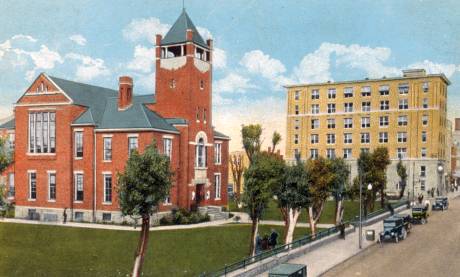
Raleigh is one of the last of West Virginia’s counties that has the
occasion to celebrate a hundredth birthday. In spite of Raleigh’s
centennial celebration, at least forty of the state’s 55 counties were
formed and in being before Raleigh was created in 1850. With Raleigh
came Wyoming county in the same year to become one of the state’s
political subdivisions.
But historically the area that makes up Raleigh county can trace
itself back farther than 1850. In 1831, for example, Fayette county
was created from Kanawha, Greenbrier, Nicholas and Logan. It had its
county seat first located at New Haven (in Mountain Cove district),
but in 1837 the county seat was moved to the site of Fayetteville
(then called Vandalia) where court was held in the tavern of Abraham
Vandall until public buildings could be completed. Too, Montgomery, in
Fayette county, began its history much earlier than Raleigh county
with the arrival of boats from Cincinnati and other points on the Ohio
to unload goods at Montgomery landing, which was then the distributing
point for merchants in what is now southern West Virginia.
Our neighboring city of Oak Hill, near which Peter Bowyer operator a
water power mill as early as 1820, received its name later from the
earliest post office established at Hill Top on the mail route from
Fayetteville to Raleigh Court House (now Beckley). On the site of Glen
Jean a water power mill was operated as early as 1850 and a post
office was established soon after 1854.
But in the interior of West Virginia, south of the Kanawha,
development was fairly well retarded. On Madison’s map of Virginia of
1807, corrected to 1818, no towns are indicated in any part of the
area and only one public road is shown. This was a road from the
Kanawha by Loup Creek and Upper Piney to Pack’s Ford at the mouth of
the Bluestone and beyond into Monroe county.
Nevertheless, by 1850 the area that is now Raleigh had developed
enough to warrant the creation of a separate county. Accordingly, on
January 23, 1850, the General Assembly of Virginia enacted the
legislation forming Raleigh county, separating the districts of Town,
Trap Hill, Marsh Fork, Clear Fork, Shady Springs and Richmond from the
county of Fayette. At the suggestion of General Alfred Beckley the
county was named in honor of Sir Walter Raleigh, soldier, sailor,
author and adventurer, who had planted the first English colony on
American shores.
In March of that year, the county government was first organized by
the "gentlemen justices" at a meeting at Beckleyville (Beckley) in the
village schoolhouse. James Goodall, Robert Scott, Samuel L. Richmond,
Robert Warden, Cyrus Snuffer, Lucien B. Davis, John T. Sarrett,
Benjamin Linkous and John Stover made up the first court.
This development of the lands that are now Raleigh was sparked through
the activities of the same General Beckley who suggested its name and
in whose honor the present county seat is called Beckley. General
Beckley in 1836 had married Miss Amelia Neville Craig of Pittsburgh.
He then resigned his commission as a first lieutenant in the Army and
moved to what was then Fayette county to improve a large tract of
unsettled lands for his widowed mother and himself. These lands now
make up a part of Raleigh county.
Largely through Beckley’s influence, the Virginia Assembly in 1837 and
1839 authorized the construction of the Giles, Fayette and Kanawha
Turnpike opening the region along its route from Giles Court House,
Red Sulphur, Indian Creek, Flat Top, Beckley, Fayetteville to the
Kanawha.
Raleigh county has a land area of 600.89 square miles which was once a
part of a great inland plateau which has been modified, in many places
beyond recognition, by the action of streams and other natural
agencies. New River, which forms the northeast boundary of the county,
has cut a winding channel through this plateau to a depth of more than
one thousand feet, and numerous tributaries of the Big Coal, the New
and the Guyandot rivers have furrowed deeply in all directions. An
area of not less than 100,000 acres lying in the interior of the
county still bears some resemblance to its original form. But even
here the slow flowing streams have left their marks, changing the once
smooth and lofty plateau into a rolling upland.
The greatest elevations in the county are to be found along the
mountains which border it on the south and west. Ivy Knob, on the
southwest rises to 3,693 feet and in several places an elevation of
3,500 feet is reached along the Great Flat Top and White Oak
Mountains. Huff’s Knob, the site of WJLS-FM, rises to 3,566 feet and
is in the Flat Top chain.
The lowest point in the county is where Coal River, on the west,
leaves the borders at 900 feet. New River, in the north leaves at
1,150 feet and the Guyandot, to the south, at 1,600 feet.
This former, smooth plateau, which we now know as Raleigh County, came
into its industrial own with the development of its coal resources.
From the first organized mine at Royal, near Prince, through the early
nineteen hundreds, Raleigh County has been one of the foremost coal
producing counties in the state. The whole area lies within the coal
section of West Virginia, the eastern three-fourths in the New
River-Pocahontas area and the western one-fourth in the
Allegheny-Kanawha area. The county has nineteen seams of mineable
coal, ranging from the Lower Kittanning to Pocahontas No. 2, and the
deposits are so distributed that the county has two acres of
underlying coal for each surface acre.
The county is the natural home for many species of valuable timber
trees. White pine once grew in abundance at an elevation of 2,500 to
3,000 feet on Glade Creek and Piney River. This area, with its
extension into Mercer County, once formed one of the three principal
bodies of White Pine to be found within West Virginia. Outside of the
white-pine belt, hemlock is the only soft wood growing in large
quantities. Yellow poplar and the oaks, principally white oak, were
the most abundant of the valuable hard woods. Extensive timber and
lumber operations were carried on at Blue Jay, Fitzpatrick, Glen
Hedrick, Hamlet and Long Bottom, but today have been greatly curtailed
with the cutting out of the timber woods.
The high, level sections of Raleigh County, which compose the greater
part of it, are good farming and grazing lands. The agricultural
products of the county are of no inconsiderable value and have added
much to the wealth and opportunity of the people. In 1949 the
formation of the Raleigh County Agricultural Commission considerably
stimulated this phase of Raleigh County’s development.
Like most other portions of West Virginia, Raleigh was settled largely
by people of Irish, Scotch-Irish and English extraction, with a slight
mingling of men of German blood and a few of the families who had fled
from France to escape the horrors of the religious wars in the unhappy
and tragic reign of Louis XV. The largest portion of Irish and
Scotch-Irish emigrants came to Raleigh County from the northern
sections of Ireland shortly before or immediately after the war of the
Revolution. Many of the Germans were soldiers who had served under the
Crown during the war, or Hessians, as they were known at that time.
The English were either the descendants of the original Virginia
settlers or British subjects seeking a wider freedom in a new
land.
These first immigrants, moving westward into what is now Raleigh
County, followed old hunting and Indian trails. Depending upon
agriculture, hunting and trapping, many hardy settlers travelled along
the river valleys and the rich bottom lands, while others crossed the
rugged mountains to the east on foot, horseback and in carts and
wagons, breaking their own trails. They carried with them only the
bare necessities, a few household items and farm implements.
From 1750, when Doctor Thomas Walker and five companions on June 28th
reached the mouth of the Greenbrier and became the first white men
crossing what is now West Virginia south of the New River, until the
first part of the nineteenth century, the area continued to gain in
population. Settlements grew and cabins dotted the landscape.
Wheeling, Clarksburg, Wellsburg, Parkersburg, Point Pleasant and
Charleston in 1800 were already frontier villages. Yet, while these
new settlements were organized as counties and subdivisions of the
State of Virginia, there developed from the very early days a clash of
economic interests and a divergence of political ideals between the
people of the eastern and western sections of the state that
culminated in the sixties in the dismemberment of the Old Dominion.
Granville Davisson Hall, first Secretary of State for West Virginia
says, "As the population increased and spread westward, great
inequalities in representation grew up. Around Williamsburg, the seat
of government, counties and settlements were subdivided into small
precincts, to each of which two members of the House of Delegates were
allowed, while no more was allotted to the larger counties farther
removed from the executive influence. No more was allowed to all West
Augusta. Representation was distributed in double, triple or even
quadruple proportions around Williamsburg to the great dissatisfaction
of people farther west."
This dissatisfaction evidenced itself formally first at the Winchester
convention of 1816 and again at Staunton in 1825. The Staunton
convention prompted the first constitutional convention for Virginia,
which meeting during 1829-30 drew up a proposed constitution for the
state that was so unsatisfactory to those who lived in what is now
West Virginia that although it was adopted it was rejected by the
westerners by a vote of 8,365 to 1,383.
The question of unequal representation for the western part of the
state in Virginia’s government continued to be unanswered even
following another constitution convention in 1850. While the new
constitution for the state did make some concessions to the west, the
east continued in the Virginia Senate its representation for
three-fifths of its slaves - then numbering near a half million - and
thus controlling the Senate could effectually check any reformatory
legislation that might be attempted. Little wonder, then, that when
the Richmond convention in 1861 offered to turn Virginia over to the
Southern Confederacy that the mountaineers revolted.
Their revolution took the form of setting up a new government of
Virginia, loyal to the Federal Government. Meeting during 1861 and
1862 at Wheeling, the restored Virginia government passed an ordinance
"providing for the creation of a new state out of the territory of
this state." A special election ratified their action by a vote of
18,408 to 781, and except for the formalities West Virginia was born.
Abraham Lincoln signed the act that on June 20, 1863 recognized West
Virginia as one of the United States.
Men from Raleigh county served with both the Federal and Confederate
forces during the war between the states, but not a great deal of
military activity occurred in the area. General Henry A. Wise of the
Confederacy was ordered to the Kanawha Valley to gain and retain
control of that entrance into Virginia. General Robert E. Lee planned
to hold the territory by posting a force below Charleston. After some
difficulty, General Wise was able to recruit about 8,000 men, some
2,000 from the families and farms of Raleigh county.
After driving back the Federal Troops of General J. D. Cox at Scary
Creek on July 7, 1861, General Wise, being threatened by another force
of Federal troops under the command of General Rosecrans, withdrew
toward the waters of the New River.
Later in August, 1861, General John B. Floyd arrived with a brigade of
Southern troops in the vicinity of Lewisburg and assumed direction of
the Confederate army in that section. During the summer he advanced to
the reinforcement of General Wise to oppose the Federal forces.
Several battles and skirmishes occurred with varying results, but in
the fall of 1861 the Confederates withdrew and the militia serving
under Generals Alfred Beckley and Augustus A. Chapman was
disbanded.
At the same time, Federal troops under General Cox occupied
Fayetteville and continued south. At Beckley there occurred a sharp
skirmish between the Confederates and the advancing Federals.
Artillery played a large part in that engagement, with cannon balls
thrown into the town. The Confederates were forced to withdraw, but
not until they disputed violently the advance of the Union forces
through Beckley and across a ford near the junction of Piney River and
Beaver Creek.
From that time, nearly a hundred years ago, Raleigh county has
continued to progress. With the coming of the railroad into southern
West Virginia in 1870, and the formation of Summers county from Mercer
in 1871, the territory took on more importance. It was during those
days that a movement was started to move the county seat from Beckley
to Trap Hill. It might have been done, except that those opposed to
the creation of Summers county under the lead of Evan Hinton failed in
their attempt to set up Summers county to include Richmond District
with a county seat at New Richmond. Had Richmond district become part
of Summers county and thus withdraw its support from those who wanted
to retain Beckley as the county seat of Raleigh, it is likely that it
would have been moved to Trap Hill.
By 1900 the Piney branch of the Chesapeake and Ohio was completed from
Prince to Raleigh station and the real growth of the county began.
Coal production in West Virginia, which already had come a long way
from its first mining and use at Wheeling in 1810, in that year jumped
another three million tons. Raleigh county was coming into its own.
New mines were opened and during the war years of 1917 and 1918,
hundreds, especially small truck mines, were started. McAlpin, a
mining town on the Winding Gulf, on the Virginia railway, became
headquarters for two large coal companies, and by 1916 had a
population of 1,000.
Lester developed largely due to mining and lumber industries. By 1916
it had nine stores, three restaurants, one sawmill, one planing mill,
three hotels and three churches, a population of about 1,200. Beckley
with a population of 342 in 1900, was incorporated as a city in 1908.
By 1916 it had ten stores, four hotels, seven churches and a high
school. Today, Beckley with a population of nearly 20,000 has an
estimated 450 retail outlets with annual sales approximately
$30,000,000.00.
Raleigh county along with the other counties of the state provided her
share of men for the first World War. During those years, the county
co-operated effectively with the Liberty Loan drives, Red Cross, and
other activities such as the famous "law against idleness." This law,
first passed by the West Virginia legislature, required every able
bodied man in the state to work at least thirty six hours a week.
During the life of the law over 800 idlers were arrested.
The story of Raleigh county is much the same during World War II. Again
the men and the women of the county responded and fought well. And,
again, as in all wars, not all returned after the fighting was
over.
The schools and churches of the county have kept pace with the other
developments. Highways have been improved, anew and a modern airport is
being completed. New businesses continue to come to the county.
Barring some unforeseen disaster, Raleigh County while looking back
over the past 100 years can proudly and with confidence go forward
with faith in the future.
Sunday is 100th Anniversary of Town of Beckley (1972)
This article appeared in the Beckley Post-Herald on Feb. 19, 1972.
By PETER A. LAQUEUR
For those people who enjoy centennial celebrations, the history of
Beckley is a gold mine. Founded in 1838 and chartered by the Virginia
Assembly, the city has gone through four different charters since that
date.
Sunday marks the 100th anniversary of the act of incorporation of 1872
- the first charter designating officers for the city. By an act of
the West Virginia Legislature on Feb. 20, 1872, Beckley was
incorporated as a town. The act read as follows:
"Be it enacted by the Legislature of West Virginia: That the place
known as "Beckley" in the county of Raleigh be, and the same is hereby
made a town corporate and a body politic by the name of 'The Town of
Beckley' and shall in all respects be subject to the provisions of
chapter 47 of the code, entitled 'of the townships and villages.'"
The next charter was granted in 1894 in order to allow for the office
of treasurer, but otherwise made little change in the operation or
function of the city. It did also expand the boundaries of the
town.
Perhaps the first real charter, that spelled out all the duties and
functions of the city officers and explained what the city was and was
not allowed to undertake came by an act of the Legislature in
1908.
This was passed in an extra session of the Legislature on Feb. 1,
1908, and was for the purpose of "reducing to one the several acts and
certificates incorporating the town of Beckley," and describing the
limits of said town."
At this time the town became known as a city. Again this charter
expanded the boundaries of the city. This charter made provisions for
mayor, recorder, treasurer, police chief, assessor, health officer,
street commissioner and five councilmen.
It is of interest to see that the office of police chief was
designated since there was no police department at that time. Not
until 1924 did Beckley have its first police department.
This charter was followed by the 1927 charter, under which the city
today operates. It too was granted by an act of the Legislature on
April 26, 1927. This charter again enlarged the boundaries of the city
and made changes in the official organization of the city.
This charter combined the offices of recorder and treasurer and lodged
much greater power into the hands of the mayor. It relieved the mayor
of the duties as police court chief and stated that "a special police
judge will be appointed by the mayor as well as firemen by and with
the consent of the council."
The bill that created this new charter was organized by a group of
citizens. It set salaries of $2,500 for the recorder-treasurer,
$1,200 for the police judge, and a minimum of $600 for the
mayor. Council members were to be paid $5 for each meeting they
attended, not to exceed two meetings per month.
An early history of the city goes back even before 1838, but little is
known of the community at that time. It was but a crossroads until the
late 1880’s.
It was founded by Gen. Alfred Beckley and named after his father John
Beckley. It became a meeting place for the visitors to the surrounding
areas, such as Prince, Winding Gulf, Beaver, Crow and so forth.
General Beckley always dreamed of the town becoming a major
agricultural center and wanted Beckley to become the seat of justice
for the new county he had been pushing - that of Raleigh.
Two years before Raleigh County became a county (being formed from
Fayette County), General Beckley donated the tract of land where the
present courthouse stands with the understanding that this land would
belong to the people of Raleigh County as long as Beckley remained the
seat of justice.
In 1850, Raleigh County was established and Beckley became the seat of
justice and has remained so to the present time. Only once was it
challenged. There was a move one time to move the courthouse to
Lester. This was defeated by the people in a special election.
General Beckley is the person responsible for the layout of the city.
The streets follow closely his map of 1848, known as the "papermap" of
Beckley.
Many of the early facts of the city were lost in the great fire of
1912, which nearly burned the entire town. It destroyed over 20
buildings mainly on Neville, Prince, and Heber Streets.
Various sources indicate 1872 when the charter was issued, found
Beckley to have for the first time a mayor. It is not known who he
was, but he could very well have been John Beckley. Prior to this
time, in accordance with the 1838 charter, there were three trustees
who were in charge of the operation of the city.
John Beckley, in his autobiography, says that he was mayor of Beckley
on and off for many years, but gave no specific dates. One of the
earliest records of mayor is 1897 when John W. McCreery held the
office.
The year 1872 saw the son of Beckley’s founder deeply involved in the
political affairs of the county.
He was clerk of the county court as well as clerk of the circuit
court. He was also a commissioner of the board of education, being
named as supervisor, and also taught school.
This year also marked the first stirring of economic growth for
Beckley, which was called Raleigh Courthouse. It saw the forming of a
new state constitution and the opening of the Chesapeake and Ohio
Railroad - its completion from the eastern seaboard to the Ohio
Valley. The train came within 10 miles of Beckley - at Prince.
There was little official law in Beckley during this time and it was
not until 1887 that the city had a police chief - John Williams. He
was a one-man force.
During the latter part of the 1880’s, until the new charter of 1908,
the city and county grew and prospered. In 1891, the first coal mine
was opened at Royal and many more followed shortly thereafter.
Business grew so much that a bank was finally established in Beckley
in 1899 with the McCreery family as the principal founder. The bank
was called the Bank of Raleigh. Prior to this time banking was carried
on in Hinton, Winding Gulf and areas around the city, but not in
them.
When the first election was held following the 1908 charter, it was
considered a pretty heated battle with the battle centered around the
races for the offices of recorder and treasurer. Lucian H. Davis was
elected recorder and J. Q. Hutchinson elected treasurer.
The mayoral race also was of interest and there are conflicting
reports as to who was actually elected mayor. One report shows that
Joe L. Smith (the father of Hulett and Joe Jr.) narrowly defeated
Robert B. Robertson. The second report indicated that Robertson won,
but died before taking office with Davis taking the office of mayor
until he resigned in 1911.
One of the first acts of the city fathers was to finance the paving of
principal streets - Main and Neville Streets and Third Avenue (where
the railroad station was).
The chores of the early city fathers were many - primarily, getting
the city out of the mud and out of debt.
A highlight of the early period was a May council meeting in 1924. The
chambers, then on South Fayette Street, were packed. The issue was one
of great importance - whether cattle were allowed in the city or
not.
Several years earlier, an ordinance was passed prohibiting this but
the pro-cattle people were so strong it was rescinded. The vote was
close. Councilman Joe Smith was absent and the remaining four voted
two "for" and two a "against." It took the vote of Mayor High Miller
to prohibit cattle in the city. In those days, it was as important as
the matters before the council today.
That same year saw Beckley establish its first police and fire
department. C. V. Cottle was appointed the first chief and he had two
men under his authority. The fire department took over the old
Presbyterian Church and to this day remains there.
The years since then have seen the city prosper to a point where it is
today - one of the most progressive and innovative communities in the
state and the center of Southern West Virginia.
Beckley Charter Much Changed Since
Inception (1972)
This article appeared in the Beckley Post-Herald on Aug. 21,
1972.
Editor’s Note: The following article is the text of a speech that
Peter Laqueur presented to the Raleigh County Historical Society Aug.
10. Laqueur used for sources information from Harlow Warren, Mrs.
Dorothy Amick and the files of Beckley Newspapers Corp.
By PETER A. LAQUEUR
History is a field that has always fascinated me, partly through the
influence of my family, which is full of amateur historians and a few
professionals. My brother presently is getting his Ph. D. in history at
Oxford.
My interest in history has not really been the scholarly pursuit,
but more of a hobby. Wherever I have gone, I have made it a point to
learn something about the history of the area, its people and its
growth.
My interest in the history of Beckley stemmed from two main sources,
the main one being Hal Scott, whose friendship and wisdom I have long
respected.
Listening to him tell stories of Beckley and Raleigh County in the
early part of this century has always fascinated me. He always told me
enough to make me go and dig a little deeper.
The second and equally important influence is Dorothy Amick, who
actually inspired me to do my first articles on Beckley when I told her
of the 100th anniversary of the 1872 Beckley Charter last Feb. 29. It
was from this that I got the real bug.
I was immensely happy when I was asked to speak before this group
because it offered me that opportunity to dig a little deeper and find
more background on the development of this great city - Beckley.
No doubt many of you are familiar with the early history of the
city, but I shall review it from the beginning, when Gen. Alfred
Beckley came here from Philadelphia in 1836 with his first object being
to create a new town. After two years of labor, the Virginia Assembly
established the town of Beckley.
There really wasn't much to it. It was a fork in the road and had,
at the most, five families in a 20-mile radius. Five trustees were
appointed to run the city but they did not have much to do because
actually there was no town. Legally the town existed but concretely it
did not.
The first duty of these five trustees, Alfred Beckley, Clarkson
Prince, William Prince, John Bailey and Richard McVey, was to lay off
the area chosen for the town and to designate streets and alleys.
The town was to be no larger than 30 acres and the five trustees had
the power to make any laws and rules that they felt were necessary.
When the trustees first met, the area was, as John Beckley, Alfred’s
son, wrote, "a howling wilderness." Little is known of what all these
men did.
Evidence of a layout for the town dates back to 1848, when Beckley
filed his "papermap" with the Fayette County Circuit Clerk. Much of
what he designed still exists today and no doubt accounts for our
traffic problems.
While these men were working on developing the town of Beckley,
General Beckley already had grander plans - that of a new county with
Beckley as its seat of justice.
The general always dreamed of the town becoming a major agricultural
center and the seat of justice.
Two years before Raleigh became a County in 1850 (formed from
Fayette County), the general donated a tract of land, where the present
courthouse stands, with the understanding that this land would belong
to the people of Raleigh County as long as Beckley remained the county
seat.
Thus when Raleigh finally became a county in 1850, Beckley became
the county seat and remains so to the present. Only once was it
challenged - when there was a movement to move the county seat to
Lester - but this was defeated by the citizens in a special election.
During this early time little is known of what took place. The Civil
War broke the calm atmosphere of the community, which was still in its
infancy.
It was not until 1872, when the second charter to the city was
granted by the West Virginia Legislature, that Beckley, then known as
Raleigh Court House for a short period, began to take the shape of a
town.
This charter designated offices for the city and Beckley found
itself with a mayor for the first time. Who he was, no one knows but it
could have been John Beckley, Alfred’s son.
The year of 1872 not only marked the new charter but also saw the
first economic stirring in the city.
First there was the new state constitution and secondly, the opening
of a railroad, the C&O, which ran from the eastern seaboard to the Ohio
Valley and came within 10 miles of Beckley.
During this time, Beckley had grown some, but the area around it
grew more rapidly. There was little action in the city and there was
also little, if any, official law. There was no police chief until John
Williams became the first one in 1887 and even then, he was a one-man
force.
We move now briefly to the 1894 charter, which allowed for the
position of treasurer but otherwise made no changes.
It was not until the turn of the century that Beckley began to move.
Between 1890 and the next charter of 1908, the city and county grew
rapidly and prospered.
The first coal mine was opened in the county in 1891 and soon
thereafter many more followed. Business grew so much that a bank was
finally established in Beckley in 1899, with the McCreery family as the
principal founder.
The charter of real importance to us was the 1908 charter granted by
the Legislature Feb. 1, 1908. This charter changed the status of
Beckley from a town to a city and outlined in detail the various
officers the city should have and what the duties of these officers
would be.
This charter made provisions for mayor, recorder, treasurer, police
chief, assessor, health officer and street commissioner and five
councilmen.
All officers except police chief, treasurer, assessor, health
officer and street commissioner were to be elected by the citizens.
Once this charter was effective, city elections were held and they
were, according to several reports, rather heated. Who actually won is
matter of conjecture. One report shows Joe L. Smith to be the winner
and another shows Robert B. Robinson winning.
Robinson died before taking office, thus passing the office to the
recorder, Lucian Davis, who later resigned in 1911. Most persons agree
that Davis was mayor and that Smith took office in 1910 and resigned in
1912 to become a state senator.
The mayor and the council had a big job - that of financing the
paving of principal streets such as Main, Neville and Third Avenue.
Their prime concern was to get the new city out of the mud and out of
debt.
One particular incident during these early years that I enjoy
concerns the matter of cows in the city streets.
The time was 1924 and it was a May council meeting. The chambers,
then on South Fayette Street, were packed. The issue was whether cattle
were or were not to be allowed to roam free in the city.
Several years earlier, an ordinance had been passed prohibiting this
but the pro cattle people were so strong that it was rescinded.
The vote was close after long debate. Councilman Joe Smith was
absent and the remaining four voted two "for" and two "against". It
took the vote of Mayor Hugh Miller to prohibit cattle in the city.
Although there seems to be much information on Beckley during the
early period, many of the official documents were lost through the
great fire in 1912, which nearly burned down the entire town. It
destroyed over 20 buildings, mainly on Neville, Prince and Heber
Streets.
In many ways, the fire was a blessing to the city. Gone were the
fire traps and dilapidated buildings. The town, in rebuilding, became a
city and more modern bigger and better church and business buildings
were erected on the ruins of the fire.
Business in Beckley was booming with large land companies coming
into the area, new rail lines being laid, coal expanding - and much
more. It headed into the late 20’s with a shot in the arm and
foresight. While the nation was struck by the depression, Beckley was
not hit as badly as the rest of the country.
It was in the latter 20’s - April 26, 1927 - that the fifth charter
was issued to the city of Beckley by the Legislature. This charter is
basically the one under which we operate today, although changes have
been made.
This charter attempted to streamline the government of the city. It
combined the offices of recorder and treasurer and lodged much greater
power in the hands of the mayor.
It relieved the mayor of the duties of police court chief and
provided for such a person to be appointed by the mayor with consent of
the council. It also gave the mayor authority to appoint firemen.
This was the last charter passed by the Legislature; further changes
in our charter have been done either by resolutions of council or
special elections.
The 1927 change was brought about through an organized citizens
group.
It upped the salaries of the official family by providing $2,500 for
the recorder-treasurer, $1,200 for the police judge and a minimum of
$600 for the mayor. Council members were to be paid $5 for each meeting
they attended, not to exceed two meetings per month.
This charter remained in effect until Aug. 3, 1954, when the voters
approved certain changes which we shall discuss shortly.
The period of 1927 to the next charter change saw a great deal of
progress being made in Beckley. It was now becoming the center of
Southern West Virginia and competed only with Bluefield for this title.
By 1930, the population of the city had jumped to 9,357 and by 1940
there were 12,852 persons in the city.
Beckley became known as the "Smokeless Coal Capital" as more and
more coal operations were opened in Raleigh County, centering
operations around Beckley.
Beckley was blessed then, as it is now, with many individuals who
had a lot of faith in the city and a lot of foresight. Paved streets
were pushed out in every direction, many costly homes were built and
large investments in business and industry were made.
As the city grew and prospered, citizens began to look at their
government and decided that changes had to be made. In the middle 40’s,
citizens groups began to look into ways of changing the charger so that
government would be smoother and more efficient.
Under the 1927 charter, the recorder-treasurer was an elected
position. There were no wards as we know them today; all councilmen
were elected at large. There were no primaries, rather, nominees were
selected in party conventions.
The big issue in the charter revision was a city manager type of
government.
Many individuals felt that the operation of the city had come to a
stage where a part-time mayor was not enough - Beckley needed a full-
time individual to run and operate the fast growing community.
The commission appointed to study the revisions came up with the
following recommendations: that primaries be held for the nomination of
municipal offices; that the city be divided into not less than five nor
more than nine wards with a councilman from each ward and two at large;
extension of terms from two to four years; that a police judge be
elected; that the recorder-treasurer be appointed instead of elected,
and a permissive clause that would allow a city manager type government
to be put into operation.
It was quite a struggle with long council meetings, citizen
discussion and a lot of lobbying. When the voters went to the polls,
they defeated the change, 1,147 to 834.
This, however, did not deter our far-thinking citizens. The
discussions on changes were constantly brought up again and again. In
the last term of Mayor W. A. E. Burke, another special committee was
appointed to propose changes in the charter.
This was presented in 1951 to the council, which debated and debated
the matter, finally deciding to let the Political Science Department of
West Virginia University go over the proposed changes and make
recommendations to the city.
For two years, the council held onto the proposed changes, doing
nothing about it. It took the courage and determination of Councilman
Clarence L. Bibb to get the matter before the public eye once again.
This time the major issue seemed to be the primary issue. The
Democrat City Executive Committee had endorsed the primary form of
nomination but the Republican committee had not. The council therefore
refused to bring up the matter. Finally in August of 1953, both parties
agreed and the matter was settled.
The first primary was held, nominating Elmer Davis as mayor for the
Democrats and George B. Chambers for the Republicans. Nothing was
decided, however, on other charter changes. This had to wait until
another year.
Toward the end of 1953, the council held public hearings on the
proposed charter changes which posed five main, basic changes: a four
year term for the mayor and council; a ward system for the city; a
permissive city manager clause (once decided, never to be changes
unless through an act of the Legislature); appointment of a city
recorder-treasurer, and the changing of the election from the first
Tuesday in October to the fourth Tuesday in May and the terms of office
to begin on July 1 instead of Jan. 1.
The council was ready to adopt these changes providing there were no
objections raised at the meeting, but, once the chambers were packed,
three individuals, the fire chief, the police chief and one citizen
outlined objections, forcing the council to hold an election.
The election was held Aug. 3, 1954, and the citizens adopted the
changes, giving us our present form of government. With this new change
came a redefinition of powers of the officers of the city but not
greatly changed from the 1927 charter.
Today Beckley is still a progressive and forward-moving community.
Although the U. S. Census Bureau says we lost population, the city
seems to be bursting at its seams. Housing is critical and if traffic
is any mark of growth, the Beckley has grown.
The state and federal governments look to Beckley as one of the
three growth centers in West Virginia.
Beckley Population
| 1880 | 144
| | 1890 | 158
| | 1900 | 342
| | 1910 | 2151
| | 1920 | 4149
| | 1930 | 9357
| | 1940 | 12,852
| | 1950 | 19,397
| | 1960 | 18,642
| | 1970 | 19,884
| | 1980 | 20,492
| | 1990 | 18,296
| | 2000 | 17,254
|
Raleigh County Population
| 1900 |
12,436 |
| 1910 |
25,633 |
| 1920 |
42,482 |
| 1930 |
68,072 |
| 1940 |
86,687 |
| 1950 |
96,273 |
| 1960 |
77,826 |
| 1970 |
70,080 |
| 1980 |
86,821 |
| 1990 |
76,819 |
| 2000 |
79,220 |
History of the Coal Industry
This article was written by Maj. W. P. Tams, Jr., President of
Gulf Smokeless Coal Co., Tams, W. Va.
Coal mining for shipment by railway was commenced in Raleigh County
opposite Prince on New River at the Royal mine and the coal was carried
by overhead buckets across the river to reach the railway since at that
time there was no bridge across New River at the mouth of Piney Creek.
Afterwards Stonewall and Terry were opened by Major Terry of Lynchburg,
and after the railway built up Piney Creek, Wright, Lanark, and
Stanaford were opened, and in 1899 the Raleigh Coal and Coke Company
began shipments. Previous to the development of Piney Creek there were
some shipments at the other end of Raleigh County by McKell, who opened
up Oswald, Sydney, and Graham in the late 1890’s. In 1906 the New River
Company built a railway from Mabscott Junction through Beckley over to
Cranberry, and opened Sprague and Skelton drift mines and Cranberry and
Prosperity shafts.
The first smokeless mine opened on the Virginian was at Eccles in
1907 and Slab Fork almost at the same time. In 1908 the Virginian
Railway commenced building the Winding Gulf Branch from Mullens in
Wyoming county up the Gulf and over the divide to the waters of Piney
Creek and up Piney Creek to Fireco. The mines opened on this branch in
order from the lower end upwards were Tarns, Stotesbury, McAlpin,
Woodbay, Big Stick, Hotcoal, Lynwin, Winding Gulf, Affinity, Sullivan,
Woodpeck, and Fireco. All of these mines on the Winding Gulf were
opened in the Beckley seam, and the mines on upper Piney in the
Firecreek seam.
In 1915 the C. & O. and Virginian built a railway line up Stonecoal,
opening up the mines on that branch, among them Frances, Tommy Creek,
Lego, Princewick, Killarney, East Gulf, Besoco, C. H. Mead, Lillybrook
mines, and Pickshin.
The pioneer operators in Raleigh county were the Laings, Major
Terry, Luckadoux, the Guggenheims, Caperton, Dixon, E. E. White, Justus
Collins, Col. Leckie, Mead, Tolliver, Prince Lilly, and E. C. Minter.
Most of the tonnage produced in Raleigh County came from the Beckley
seam in the Winding Gulf and Stonecoal, and was shipped in the
beginning over the Virginian Railway, which having only an outlet to
tidewater was able to return cars promptly to the mines and thus gave
operators on the Virginian Railway every-day operation, when their
competitors on the C. & O. Railway and the N. & W. Railway were only
able to secure cars for three or four days per week. During World War I
the Government took over all the railways and furnished sufficient
capital to equip the railways with enough cars and locomotive power to
furnish everyday run to the mines, which Immediately resulted in
supplying too much coal to the market. After World War I the succession
of strikes in the organized coal fields, in the anthracite field, on
the railways, and in England, resulted in a temporary boom market for
coal during the 1920’s until the depression in the fall of 1929. During
the depression the mines were able to operate, but at reduced prices
and under unsatisfactory reduced wage conditions. The coal business
picked up in 1933, but was again in difficulties when World War II
commenced In Europe, followed by the entry of this country into the
War. During this period, and for four or five years after the World War
II ended, the coal business was in good condition, but since 1950 the
market and price have been unsatisfactory in the extreme. The mines in
Raleigh County find their main market now in the metallurgical
business, being used to make coke for the steel mills. The cost of coal
in Raleigh county is now such that the mines can not compete
successfully in the steam market which can secure low cost coal from
the high volatile fields where mining conditions are more favorable.
The quality of the coal in Raleigh county remains the same, but the
markets have become restricted. The Beckley seam has been practically
exhausted in Raleigh county with very little tonnage now mined from
this seam. The Sewell seam is almost exhausted, and the future of the
coal business in Raleigh county lies in the Pocahontas No. 4, and the
Pocahontas No. 3 seams. These seams are now being operated, and it is
probable that within ten years they will be the only seams operating in
the county. Mechanization of (he coal mines has become a necessity due
to competition, and this, of course, has reduced the number of men
required in the mines. Shrinking of the markets for coal has made a
further reduction in the number of men employed and Raleigh county
should now look to additional sources of employment of labor for the
future.
Some Beckley Weather Extremes
| late 19th century | -20° (newspaper quote of meteorologist)
| | Dec. 30, 1917 | -20°
| | May 9, 1923 | 9 to 10 inches of snow
| | July 20, 1926 | 103°, highest temperature ever in Beckley,
recorded by D. G. Williams
| | Apr. 27, 1928 | 20 inches of snow
| | Aug. 1, 1931 | 94°
| | 1931 | "the hottest summer ever in Beckley"--Bob Wills
| | Sept. 1, 1932 | 96°
| | Sept. 2, 1932 | 97°
| | Sept. 1933 | 97°
| | Aug. 21, 1936 | 95°
| | Jan. 22, 1936 | -10°
| | Jan. 23, 1936 | -19°
| | Jun. 30, 1936 | 100°, recorded by Mauck, "highest
in 6 years"--Beckley Post Herald
| | July 10, 1936 | 96°
| | Jan. 19, 1940 | -12°
| | Mar. 3, 1942 | 20 inches of snow in 2 to 3 hrs
| | Dec. 11-16, 1944 | 28 inches of snow
| | July 28, 1952 | 95°
| | Jan. 24-25, 1961 | -14, 13 inches of snow
| | Oct. 20, 1961 | 8 inches of snow, much damage because trees
were full of leaves
| | Dec. 12, 1962 | -6°
| | Dec. 28, 1967 | 13.7 inches of snow
| | Jan. 3, 1968 | 19.3 inches of snow
| | Feb. 4, 1970 | -10°
| | Jan. 27, 1972 | -15°
| | Dec. 2-3, 1975 | 15 inches of snow
| | Jan. 17, 1977 | -18°
| | Jan. 20, 1982 | -20°
| | Feb. 10-11, 1983 | 14.4 inches of snow in 24 hours
| | 1984 | the lowest temperature this year was -13°
| | Jan. 19, 1984 | -5°
| | Jan. 21, 1985 | -22° at 2 a.m.
| | July 16, 1988 | 93°
| | Mar. 12-13, 1993 | nearly 19 inches of snow from 3:30 p.m. to 3:30 p.m., record for 24 hours;
the March 12-14, 1993, blizzard
dumped 28 inches of snow
in Beckley in a 24-hour period
| | Jan. 19, 1994 | -19°
| | Jan. 27, 1998 | 38 inches of snow in the Beckley area;
on January 28, 31 inches of snow
fell in a 24-hour period
| | Sept. 14, 1998 | 91°
| | Jan. 24, 2005 | -3°
| | July 21, 2011 | 92°
| | June 29, 2012 | 96°
| | Sept. 10, 2019 | 92°
|
Sophia McGinnis Found
This article appeared in the Raleigh County Gulf Times, Volume 7,
No. 50.
By PAULINE HAGA
The mystery has been solved for the town of Sophia.
The lady from whom the name of the town is derived has been missing
for some time. She has been the subject of search for several years
by historians.
In fact, she became of special interest during the nations
bicentennial year in 1976 when Sophia wanted to pay special tribute
by marking her grave.
Many oldtimers for years declared she was at rest in an unmarked
grave in a cemetery between the two tunnels in Sophia. Others say she
may be buried in an old cemetery above the old Stewart Brown property
near Soak Creek.
Sophia Mayor Mary Martin said, "I was told years ago that she is
buried somewhere out near Flat Top."
A search of some cemeteries did not turn up anything for historians.
Then The Gulf Times "reopened the case" and great-granddaughter Mrs.
Ina Meadows of Egeria learned of the search.
She informed the Gulf Times that Sophia Gravley McGinnis was her
great-grandmother, and that Sophia took sick and died while visiting
her daughter, Betty, at Flat Top.
She was born in 1812 and lived to be 104 years old. She died in
March of 1916. Mrs. McGinnis was a native of Virginia and was a widow
in 1866 when she married for the second time, a well known Raleigh
Countian, Pyrrhus McGinnis. He owned 2,000 acres of land at one time
along Soak Creek, according to family records.
The late Stewart Brown, who lived well into his 90s, always laid
claim to having the town named after the widow Sophia McGinnis. She
supposedly lived in a log cabin between the two tunnels on McAlpin
Mountain.
Brown always said "when the town wanted to be incorporated, they
wanted a name." Thus the town was incorporated in 1912 and became
Sophia.
And its pioneer citizen, Sophia Gravley McGinnis, who must have felt
proud that a town was named in her honor, is at rest in a beautiful,
neat and tranquil cemetery called the Brammer Cemetery on the Egeria
Road near Flat Top.
To "our mother," Sophia Gravely, August 15, 1812, to March 1916, it
says "death is eternal, why should we weep."
Friday’s Fire Latest of Many Major Beckley Fires
(1986)
This article appeared in the Register-Herald on April 12,
1986.
By VAUGHN RHUDY
Friday’s fire in downtown Beckley is not the first to cause major
damage to businesses in the downtown area.
The city’s history is speckled by numerous news accounts of major
fires, some even occurring in the same block that was hit Friday.
The first record of a devastating fire was printed in the April 18,
1912, edition of The Raleigh Register. Fire erupted in the rear of what
was known as the Rose & Turner Co.’s building on the corner of Heber and
Neville streets early one Sunday morning. The fire was confined to three
blocks in the business section but caused heavy damage, estimated at the
time at about $275,000.
News accounts of the 1912 fire became embellished by newspapers in
other cities. One account in a Charleston newspaper placed the limits of
the fire at a residence which actually was in Pineville and at a depot
six miles away from the city.
In 1919, the city experienced several major fires. On April 16 of
that year, fire destroyed two city landmarks, the old Hull store on the
corner of Main and Kanawha streets and what was known as the old Trail
building across the street. In both cases the fires were believed to
have been started by electric irons.
Earlier that same morning a building on the corner of Main and Heber
streets was seriously damaged.
In July of that year a Sunday night fire destroyed six buildings and
damaged three others. The entire business district of the city was
threatened.
The fire was discovered in the rear of the Toney Alloy grocery store,
located in an old frame building on the corner of Main and Kanawha
streets. The fire caused losses to two dozen businesses and individual
property owners.
Because the air was still, firefighters were better able to control
the fire, according to news accounts. Still, the force of the fire
caused the windows of the Beckley Hotel to shatter.
A major fire struck again on April 30, 1923, at the old Raleigh
County Bank Building on the corner of Main and Fayette streets. The
building was occupied on the ground floor by the Beckley Post Office and
the B&M Restaurant, which was preparing to open at the time. The fire
apparently originated in the rear of the restaurant. Damage was
estimated at $150,000.
A news account said the fire was discovered by J. D. McGinnis, who
rented rooms on the third floor. He was awakened about 2 a.m. on the 30th
by smoke. “He immediately rushed to the Beckley Hotel and found Henry
Lemon, night watchman, and with him returned to the building,” said a
story in the March 2, 1923, edition of The Raleigh Register. “They
managed to get two families out who were living on the third floor.”
On December 26, 1925, the Hub Store, located on Heber Street, was a
fire that apparently began in the basement of the building, which was
owned by L. J. Fink. The building now houses the Hub & Vogue, which still
is in the Fink family. For a time, the fire threatened to wipe out the
entire block. Damage was estimated at more than $100,000.
In February 1927 another fire destroyed a cafe on Main Street and
badly damaged two other stores.
In February 1930 fire gutted Abe’s Army and Navy Store on Neville
Street. The fire also damaged a cafe, a hotel and the Gus Farris
building. Damage was estimated at $50,000.
Another major fire occurred in March 1938. The blaze that started in
the stock room and basement floor of the then-occupied G. C. Murphy store
threatened nearby buildings.
Ironically, the Lilly Building, which was heavily damaged Friday,
was filled with smoke in the 1938 blaze. Damage climbed above $100,000.
In April 1939 fire damaged a dozen businesses in the Smith Building
on Main Street.
One of the worst fires in the city’s history occurred in November
1951 when the Aracoma Hotel on Main Street was razed by fire. Though no
deaths were reported, firefighters at first feared the building’s
occupants had not escaped. The hotel’s 35 occupants, however, had been
evacuated.
Another major fire occurred in April 1965 at the Duncan-Catron Motor
Co. on Prince Street. The fire destroyed offices and six apartments.
Thirteen people were inside the building at the time, but no injuries
were reported.
A New Year’s Day fire in 1966 at the President Hotel on Neville
Street sent two people to the hospital with smoke inhalation.
In May 1968 a fireman suffered first-degree burns after trying to
fight a blaze that caused heavy damage to a building called the East
Main Motel, located at the time at 108 E. Main St.
Several downtown stores were threatened by a fire that began at what
was known at the time as Ramey’s Grill in March 1972.
In July 1974 fire engulfed a downtown clothing store, the Slack Rack,
on Neville Street. Neighboring businesses suffered some smoke and water
damage.
Five downtown businesses were damaged in March 1976 when a fire broke
out in the storage room of Watkins Gift shop on Heber Street. The other
four businesses that were damaged at the time were the Hub and Vogue
clothing store, the National Finance Co., Marty’s Furniture store and
the Noor and Lyle photography studio.
Ironically, Friday’s fire was in the same vicinity as the March 1976
fire.
Bradley Man Recounts Story Behind
Quaint W. Va. Town (2003)
This article appeared in the Register-Herald on May 26, 2003.
By JOHN BLANKENSHIP
Picture caption: Bradley resident George Barbera, standing in front of the new Bradley post office, recalls how his father, Joseph, gave the community of Bradley its name in the mid-1940s. Today, Bradley remains a viable community, home to several businesses and residences.
Omar Nelson Bradley is best known for being America’s five-star general who during World War II commanded the U.S. 12th Army in Europe.
But he also provided the name for a quaint West Virginia town in Raleigh County.
George Barbera recalled how his father, Joseph, gave the community of Bradley its name in the mid-1940s.
"After World War II, my mother and I went to see Congressman Dr. E.H. Hedrick," the 85-year-old Bradley resident said. "We told him we needed a post office where we lived. 'Yes, you do,' the congressman told us, but he said we had to have a name for it. 'What do you want to call it? Barberaville?' the congressman asked. 'No,' my mother said. 'We don't want to do that.'
"Congressman Hedrick said he had a friend named Omar Bradley, who was general of the Army in the European theater," Barbera continued. "He said Gen. Bradley would be glad to lend his name to your community."
The famous general even came to southern West Virginia and dedicated the community in 1946.
However, the manner of how the community came about is another story that has its beginnings across the Atlantic Ocean in Sicily.
"My grandfather, Caesar Barbera, was an immigrant who came to the coalfields to work in 1900," the Bradley resident said. "When he landed on Ellis Island, he was asked if he wanted a job. He said, 'yes.' He hopped a train and came to Thurmond. He had to walk to Glen Jean where the coal company gave him a job loading coal."
One of the first things the company had to do was build a railroad to the mine at Tamroy, located at the head of Dunloup Creek in Raleigh County.
"My grandfather got a job on the railroad and became a section boss," Barbera said. "They paid him $2 a day, while the workers got only $1 a day. He lived in box cars and eventually saved enough money to go back to Sicily."
Once back in Europe, Barbera’s grandfather bought a farm with his savings. Although Caesar never returned to America, he sent his children, including Barbera’s father, Joseph, to the United States to find work.
"My father also came to Tamroy and got a job in the mines," Barbera recalled. "One brother would send for another if they could find a job. They were all good workers. Two of my uncles, Nunzio and Pasquale, were twins. One got killed the mines at Kilsyth in Fayette County and is buried in Mount Hope."
It was at that time Barbera’s mother came into the picture.
"My father met his future wife at Kilsyth," Barbera recounted. "She was only 14 when they married. My parents had six boys and four girls. I was the oldest child in the family. My mother wanted girls, but she kept having boys."
Joseph worked at Tamroy until 1929.
"Dad wanted out of the mines and went into the bakery business in Mount Hope," Barbera said. "Italian bread would be the way to go. All during the Depression and through World War II, he baked bread."
In 1942, Joseph bought what was known as the Bailey Farm, a large tract of land where Bradley sits today.
"There weren't many people in the area at that time," Barbera explained. "During the war years, people were encouraged to farm. My mother got a petition and presented it to the War Manpower Commission and asked the Beckley Water Co. to extend service from Prosperity to the Bailey Farm."
It was at this point that Barbera and his mother approached Congressman Hedrick about the post office, and Bradley was born.
By the time the community was dedicated, Joseph had closed the bakery and sold the farm to T.E. Duncan, who also bought Joseph’s building and put the new post office in it.
"Although the town has a new post office now, the old building is still there," Barbera said.
Today, Bradley remains a viable community, home to several businesses and residences.
Barbera doesn't mind telling the story of how Bradley got its name. In fact, its his mission:
"I want everyone to know the history so it will not be forgotten."
Some Railroad Dates (2011)
The following article was contributed by David K. Shumate of Roanoke, Va. It was revised on Oct. 8, 2011.
The last regularly scheduled passenger trains to and from Beckley ran on December 17, 1949. These were C&O Trains #’s 155-158, more commonly called "Old Fanny". The morning train ran from Quinnimont through Prince, up the Piney River to Beckley Junction (behind the old Beckley Hospital, down where Southland used to be) and into Beckley. After a short time, it would back down to the junction, proceed through Mabscott and Cabell Heights to Surveyor and Lester. At Lester it would turn, return to Beckley Jct, then back up to Beckley and pull out for Raleigh, Prince and Quinnimont. The afternoon train omitted the jog to Lester after the early 1920’s. Until 1938 one run passed through Beckley and went to Cranberry and return.
In addition, until December 2, 1933, the Virginian Railway ran a daily passenger train from Princeton to Mullens, Pemberton, Raleigh "Y" and Beckley. The return trip ran Beckley to Pemberton, then to Fireco and back to Pemberton, then on through Sophia and Amigo to Mullens. On September 8, 1933, the eastbound trip suffered a collision at Amigo which resulted in the death of the engineer. After discontinuance of the Pemberton to Beckley leg, this train continued to operate from Mullens to Fireco until December 21, 1940. It also served the Wyco and Winding Gulf branches. Until 1937 it connected with a mixed train from Princewick to Amigo. In earlier years, as many as three round trips per day ran the Mullens to Fireco line. Service wilted with the coming of paved roads and the vigorous competition of the Consolidated Bus Lines.
The last regularly scheduled passenger train through Raleigh County ran on the Virginian Railway between Roanoke and Charleston. This train, #’s 3-4, entered Raleigh County near Hotchkiss, ran through Slab Fork, Lester, Surveyor, Eccles, Harper, Cirtsville and into Fayette County near Pax. Through train service began on the Virginian in 1909. It was discontinued incrementally as follows:
1) Ran Roanoke to Charleston until January 25, 1952.
2) Ran Roanoke to Deepwater Bridge, West Virginia until June 20, 1952.
3) Ran Roanoke to Page, West Virginia until December 31, 1954.
4) Ran from the West Virginia state line near Oney’s Gap in Mercer County to Page in Fayette County, West Virginia until July 11, 1955.
Prior to the completion of the Deepwater Bridge over the Kanawha River, cars from this train ran via C. & O. trains #33-34 from Deepwater to Huntington, West Virginia and/or Ashland, Kentucky. Beginning on March 16, 1931 this train was rerouted via Deepwater Bridge and the Ohio Central Division of the New York Central to Charleston. This train carried a "club car" with parlor seating, meal facilities and an observation platform until the early 1930’s. Train #3 wrecked at Lester, killing the fireman, on December 13, 1935. A companion train, #5-6 ran from Princeton to Deepwater, and for a short time to Charleston, from the early 1920’s until its discontinuance about 1932.
Some of these trains carried Railway Post Office cars which provided for the sorting and handling of mail. The postmarks used for the C&O trains were "Quinnimont & Lester R.P.O.", for the Virginian on the Winding Gulf was "Fireco & Mullens R.P.O." and on the mainline of the Virginian was "Roanoke & Charleston R.P.O." All of these trains were powered by steam locomotives until their last runs.
Raleigh County Post Offices
| Abney | 1907-Date
| | Abraham | 1909-1962
| | Affinity | 1912-1962
| | Allentown | 1920-Date
| | Ameagle | 1915-DPO
| | Amigo | 1904-Date
| | Arnett | 1903-Date
| | Artie | 1903-1991
| | Atkinsville | 1935-Date
| | Beaver | 1839/Date
| | Beckley | 1916-1964
| | Besoco | 1964-1976
| | Besoco Rur. Sta. | 1916-1964
| | Birchton | 1930-1958
| | Blockston | 1881-1891
| | Blue Jay | 1906-Date
| | Bob | 1902-1905
| | Bolt | 1902-Date
| | Bone Lick | 1933-1934
| | Bradley | 1948-Date
| | Brechenridge | 1877-1885
| | Brooklyn | 1930-1966
| | Bryson | 1902-1926
| | Cherry Creek | 1943-1953
| | Cinco | 1919-DPO
| | Cirtsville | 1886-1932
| | Citie | 1904-1916
| | Clear Creek | 1867/Date
| | Coal City | 1930-Date
| | Coal River Marshes | 1835/1892
| | Coalgate | 1891-1895
| | Colcord | 1908-2002
| | Cole | 1892-1898
| | Cool Ridge | 1925-Date
| | Covey | 1902-1906
| | Crab Orchard | 1911-Date
| | Cranberry | 1906-1997
| | Crimson | 1916-1917
| | Crow | 1889-1963
| | Dameron | 1899/1935
| | Daniels | 1881/Date
| | Darlow | 1910-DPO
| | Delbert | 1916-1918
| | Dillon | 1913-1919
| | Dorothy | 1907-Date
| | Dry Creek | 1884-Date
| | Dugout | 1901-1910
| | East Beckley | 1925-1956
| | East Gulf | 1915-1984
| | Eccles | 1907-Date
| | Edwight | 1920-1959
| | Egeria | 1878/1962
| | Embury | 1905-1908
| | Emerson | 1912-1915
| | Epperly | 1916-1963
| | Esau | 1916-1918
| | Eunice | 1929-1966
| | Fairdale | 1939-Date
| | Fireco | 1916-1959
| | Fitzpatrick | 1905-1934
| | Ghent | 1903-Date
| | Glen Daniel | 1921-Date
| | Glen Hedrick | 1926-1935
| | Glen Morgan | 1910-Date
| | Glen White | 1909-Date
| | Glomera | 1884-1903
| | Grandview | 1887/1954
| | Gulf | 1909-1912
| | Hampton | 1891-189?
| | Harper | 1903-Date
| | Harpers Valley | 1851-1852
| | Harvey | 1890-1902
| | Hazy | 1924-1955
| | Hecla | 1899-1913
| | Helen | 1919-Date
| | Honaker | 1904-1908
| | Hotchkiss | 1904-1959
| | Hotcoal | 1909-1939
| | Jap | 1906-1911
| | Jarrolds Valley | 1856/1928
| | Jonben | 1921/Date
| | Josephine | 1946-Date
| | Jupiter | 1884-1884
| | Killarney | 1917-1966
| | Klemeta | 1924-1928
| | Lanark | 1901-Date
| | Launa | 1884/1912
| | Lawson | 1886-1915
| | Leevale | 1921-1953
| | Lego | 1917-1959
| | Lester | 1885-Date
| | Long Bottom | 1926-1936
| | Lumberman | 1922-1926
| | Mabscott | 1904-Date
| | MacArthur | 1942-Date
| | Madeline | 1927-1933
| | Malco | 1933-1936
| | Manatus | 1918-1920
| | Marfork | 1915/1960
| | Marshes | 1892-1921
| | Masseysville | 1906-1917
| | Matville | 1867/1913
| | Maynor | 1910-1954
| | McAlpin | 1909-1908
| | McCreery | 1905-1944
| | Mead | 1930-1988
| | Metalton | 1917-1936
| | Midway | 1946-Date
| | Millers Camp Branch | 1871-1903
| | Montcoal | 1917-1997
| | Mountainview | 1901-1967
| | Munition | 1918-1942
| | Naoma | 1926-Date
| | Ned | 1905-1911
| | Nesco | 1902-1926
| | New | 1891-1950
| | Noble | 1902-1908
| | Norvell | 1935-1945
| | Odd | 1886-Date
| | Oley | 1889-1906
| | Oswald | 1927-1953
| | Otis | 1908-1910
| | Oxley | 1915-1926
| | Packsville | 1919-1965
| | Packsville Rur. Sta. | 1965-1979
| | Peachtree | 1890-1907
| | Pear | 1899-1941
| | Pemberton | 1886-1993
| | Penman | 1937-1943
| | Pettus | 1927-1967
| | Pettus Rur. Sta. | 1967-1978
| | Phipps | 1882-1884
| | Pickshin | 1917-1929
| | Pineknob | 1916-1965
| | Piney View | 1940-Date
| | Pluto | 1901-1963
| | Posey | 1903-1957
| | Price Hill | 1907/1955
| | Princewick | 1935/Date
| | Prosperity | 1878-Date
| | Pumpkintown | 1890-1891
| | Raleigh | 1893-1896
| | Raleigh C.H. 1 | 1851-1893
| | Redbird | 1890-1924
| | Rhodell | 1917-Date
| | Richman Falls | 1856/Date
| | Riley | 1905-1932
| | Rock Creek | 1948-Date
| | Round Glades | 1858/1880
| | Rowan | 1903-1906
| | Roxie | 1881-1901
| | Royal | 1915/1937
| | Saxon | 1898-Date
| | Semoco | 1937-1939
| | Shady Spring 1 | 1849/1925
| | Shady Spring 2 | 1925-Date
| | Shell | 1881-1882
| | Sink | 1882-1894
| | Skelton | 1906-Date
| | Slab Fork | 1908-Date
| | Soak | 1901-1901
| | Soak Creek | 1875-189?
| | Sophia | 1909-Date
| | Sprague | 1908-DPO
| | Stanaford | 1902-Date
| | Stickney | 1921-1990
| | Stonewall | 1901-1925
| | Stotesbury | 1910-1963
| | Stotesbury Rur. Sta. | 1963-1972
| | Stover | 1909-1933
| | Sullivan | 1908-1977
| | Sundial | 1941-Date
| | Sunflower | 1875-1898
| | Surveyor | 1905-Date
| | Sutphin | 1904-1911
| | Sweeneyburg | 1906-1913
| | Sylvia | 1906/1926
| | Tam | 1909-1910
| | Tamroy | 1914-1941
| | Tams | 1912-1988
| | Terry | 1905-1924
| | Ury | 1923-1964
| | Ury Rural Sta. | 1964-1969
| | Vanwood | 1917-1930
| | Viacova | 1917-1922
| | Vista | 1884-1903
| | Voorheis | 1901-1904
| | Warden | 1899-1923
| | Whitby | 1919-1988
| | White Oak | 1946-Date
| | Wickham | 1927-Date
| | Winding Gulf | 1909-1981
| | Wittenberg | 1906-1907
| | Wittenburg | 1906-1906
| | Wright | 1924/1925
| | Zada | 1903-1921
|
|