Last revision: Sept. 30, 2021
The Domestic Names Committee of the U.S. Board on Geographic Names does not use apostrophes in the official spellings of place names. This Wall Street Journal article reports, “While administrative names can endure (Prince George’s County, Md.), the committee has granted only five possessive apostrophes in 113 years: MARTHA’S VINEYARD, Mass.; IKE’S POINT, N.J.; JOHN E’S POND, R.I.; CARLOS ELMER’S JOSHUA VIEW, Ariz.; and—in 2002— CLARK’S MOUNTAIN, Ore.” [Charles Turner]
ACCEDED, BAGGAGE, CABBAGE, DECEDED, DEEDEED, DEFACED, DEFADED, DEGAGEE, EFFACED, GEAGGED, and FEEDBAG are seven-letter words which can be played on a musical instrument.
CABBAGED, BEBEDDED, BEDEAFED, DEBADGED, DEBAGGED, and BAGGAGED are eight-letter words.
If you allow hyphens, there are CABBAGE-BED, BEADED-EDGE, and FACE-BEDDED. CABBAGEFACED, although not in dictionaries, is a longer such word [Stuart Kidd, Philip Bennett, Joseph Krol, Paul Wright].
However, the world’s longest acronym according to the Guinness Book of Words is NIIOMTPLABOPARMBETZHELBETRABSBOMONIMONKONOTDTEKHSTROMONT (56 letters, 54 in Cyrillic). Found in the Concise Dictionary of Soviet Terminology, it means: The laboratory for shuttering, reinforcement, concrete and ferroconcrete operations for composite-monolithic and monolithic constructions of the Department of the Technology of Building-assembly operations of the Scientific Research Institute of the Organization for building mechanization and technical aid of the Academy of Building and Architecture of the USSR [Stuart Kidd].
From the Paris climate talks in 2015 comes CBDRILONCWRC (12 letters). It stands for “Common But Differentiated Responsibility In Light Of National Circumstances With Respective Capability.” [Charles Turner]
PAKISTAN, TANZANIA. The Encyclopaedia Britannica has “In a 1933 pamphlet, Now or Never, Rahmat Ali and three Cambridge colleagues coined the name as an acronym for Punjab, Afghania (North-West Frontier Province), Kashmir, and Indus-Sind, combined with the -stan suffix from Baluchistan (Balochistan). It was later pointed out that, when translated from Urdu, Pakistan could also mean ‘Land of the Pure.’” From Wiki: “The name ‘Tanzania’ was created as a clipped compound of the names of the two states that unified to create the country: Tanganyika and Zanzibar. It consists of the first three letters of the names of the two states ... and the suffix ‘ia’ to form Tanzania.” [Charles Turner].
ADORKABLE is the first word to be added to a dictionary as a result of an Internet vote. Twitter voters chose the word, popularized by Zooey Deschanel in TV show New Girl, to be added to the Collins English Dictionary in 2014. More information is here. [Charles Turner]
AEGILOPS (alternate spelling of egilops, an ulcer in a part of the eye) is apparently the longest word in W2 which consists of letters in alphabetical order. Aegilops is also also a genus of mollusc and a genus of grass [Charles Turner]. CHILLLOSS (the opposite of a heatloss) has its letters in alphabetical order, although this word may not be in any dictionary [Word Ways]. BEEFILY and BILLOWY are the longest such words in OSPD2+. Update: Mike Turniansky reports that new six-letter words with the letters in alphabetical order added to the Scrabble dictionary in 2014 are: AGLOOS, BLOOPY, DEHORS, DHIKRS, GLOOPS, and GLOOPY.
Seven-letter words from the OED2 with their letters in alphabetical order are: ACCENTY, ACCOMPT, ADDILLS, AFFORST, ALLOQUY, BEGHOST, BELLOOT, DEGLORY, FILLOPS, and FILLOTT [Philip Bennett].
Six-letter words with their letters in alphabetical order include: ABBEIT, ABBESS, ABBEST, ABDEST, ABHORS, ACCENT, ACCEPT, ACCESS, ACCLOY, ACCOST, ACHILL, ACKNOW, ADDEEM, ADDERS, ADEMPT, ADHORT, ADILLS, ADIPSY, ADORTY, AFFLUX, AGHILL, ALMOST, ANOPSY, BEFIST, BEFLOW, BEGILT, BEGINS, BEGIRT, BEKNOW, BELLOW, BENOTT, BIJOUX, BILLOT, BIOPSY, BLOOPS, BLOTTY, CHILLS, CHILLY, CHIMPS, CHINNY, CHINTZ, CHIPPY, CHIRRS, CHITTY, CHIVVY, CHOOPS, CHOOSY, CHOPPY, CLOOPS, CLOTTY, DEFLOW, DEFLUX, DEHORT, DIKKOP, DILUVY, DIMPSY, EFFLUX, EFFORT, ELLOPS, FILMOT, FLOORS, FLOPPY, FLOSSY, GHOSTY, GILLOT, GLOPPY, GLOSSY, GOOSSY, KNOPPY, and KNOTTY [Philip Bennett, Bruce D. Wilner, Mike Turniansky, Denis Borris, Stuart Kidd, Eric Brahinsky].
This page lists 860 words in English which have their letters in alphabetical order.
The following words in the on-line Scrabble dictionary have symmetrically distributed letters: WIZARD, HOVELS, BEVY, GIRT, GRIT, IZAR, LEVO, TRIG, VOLE, WOLD, BY, LO, and SH [Mark D. Lew, Dan Tilque, Bruce D. Wilner]. There is also ZYBA (a town in Kansas), which was named by taking the last two letters and the first two letters of the alphabet [Don Blevins in Peculiar, Uncertain & Two Egg]. POLK is the only last name of a U. S. President with symmetrically distributed letters. “Symmetrically distributed letters” means that, for example, in BEVY the B and Y are equidistant from the center, as are E and V. Kieran Child points out that if you allow the central letter to be a “pivot” then the word BIGOTRY works and is even longer than wizard and hovels.
Some common words which change from one to three syllables upon the addition of just one letter are: ARE/AREA, CAME/CAMEO, CRIME/CRIMEA, GAPE/AGAPE, HOSE/HOSEA, JUDE/JUDEA, LIEN/ALIEN, OLE/OLEO, RODE/RODEO, ROME/ROMEO, SMILE/SIMILE and WHINE/WAHINE. (Wahine is defined as a Polynesian woman or a female surfer in MWCD11.) There are numerous other examples involving more obscure words [Jim Lizzi, Stuart Kidd, Philip Bennett, Charles Turner].
[An alternate solution this question is the word "language." The person actually says, "Think of words ending in -gry. Hungry and angry are 2 of them. There are three words in the english language. What is the third? You use it every day. If you paid attention I have already told you the answer."
Buckminster Fuller coined the word LIVINGRY as the opposite of weaponry, which he called KILLINGRY [Charles Turner].
On Aug. 18, 2002, the New York Times Magazine had the following sentence: “Baseball suffered the triple threat of steroids, strikes, and Seligry.” This -gry word, which is not in any dictionaries, is a play on the name of Bud Selig, the Commissioner of Baseball [Fred Shapiro]
On Jan. 2, 2012, a Tampa Tribune columnist wrote, “Why does ‘Youngry’ just get to go on Raheem’s tombstone?” He was referring to Raheem Morris, the head coach of the Tampa Bay Buccaneers football team, which had just concluded a losing season with young players.
HANGRY was published at collinsdictionary.com in 2012. It has “(humorous) irritable as a result of feeling hungry.” [Charles Turner]
In Dutch, there are jij (you), pijjekker (pea-jacket, although not found in dictionaries), schrooiijzer (upstanding cutting iron for bars, rods), sjiiet (follower of the Shia), snijijzer (cutting iron), uitdijing (expansion), and zijig (effeminate) [Oscar van Vlijmen, René Davids].
In Lithuanian, jiji is an archaic Lithuanian form of "him" consisting exclusively of dotted letters, and kraujijimas is archaic for "staining with blood" [Juozas Rimas].
In Swahili, jiji means "city" and kijiji means a small city or village [Gerald Gathuto].
In Hungarian, jöjjön (meaning "he should come") has seven dots in a row [Maryam Frazer].
In Finnish, pääjääjää (meaning "the main stayer," partitive case) has 14 dots in a row, according to Pertti Malo, who writes that a person at the Research Institute for the Languages of Finland "writes to me that 'in theory' she would approve this word." Malo writes that there are so many ways to create a Finnish word that it would be impossible to collect them all in a dictionary. A website (in Finnish) estimate there are 1024 Finnish words.
A property development company in the Canadian territory of Nunavut is the Katujjijiit Development Corporation, with six consecutive dotted letters [Craig Rowland].
The earliest known use of CATENARY in English is by President Thomas Jefferson. He also is thought to have coined NEOLOGIZE, BELITTLE, ANGLOPHOBIA, ODOMETER, OTTOMAN, and PEDICURE [Thomas Dickson, Words from the White House; Charles Turner]. The earliest known use of MILEAGE is by Benjamin Franklin.
Barry Harridge reports that in Chambers the eight spellings of CATERCORNER are surpassed by the number of variants for GALLABEA which can also be spelled gallabeah, gallabia, gallabiah, gallabieh, gallabiya, gallabiyah, gallabiyeh, galabea, galabeah, galabia, galabiah, galabieh, galabiya, galabiyah, galabiyeh. Friederike E. Droegemueller adds these spellings: Djellabah, Jellaba, Djallabea, Jalaba, Djelaba. She writes, "I saw all of these spellings, and more, in Morocco. It is, by the way, the same garment, regardless of spelling."
Eric Brahinsky has found that W3 gives ten spellings for the plural of Kirghiz (the name of an Asian people): KIRGHIZ, KIRGHIZES, KIRGHESE, KIRGHESES, KIRGHIS, KIRGHISES, KIRGIZ, KIRGIZES, KHIRGHIZ, and KHIRGHIZES. (The singular form has five spellings in W3.)
Eric Brahinsky has found that W3 gives twelve spellings for the plural of Haftarah (the singular of which has four spellings shown). The plurals are: HAFTAROTH, HAFTAROT, HAFTARAHS, HAPHTAROTH, HAPHTAROT, HAPHTARAHS, HAFTOROTH, HAFTOROT, HAFTORAHS, HAPHTOROTH, HAPHTOROT, and HAPHTORAHS.
Gloria Donen Sosin says she has found 16 spellings for HANUKKAH (in alphabetical order): Channuka, Channukah, Chanuka, Chanukah, Chanuko, Hannuka, Hannukah, Hanuka, Hanukah, Hanukkah, Kanukkah, Khannuka, Khannukah, Khanuka, Khanukah, and Khanukkah. (Her list may include transliterations from Hebrew to English.) James A. Landau has found Chanuccah in an 1872 prayer book.
The name MUAMMAR KHADAFI has 32 variants according to the Library of Congress. (1) Muammar Qaddafi, (2) Mo'ammar Gadhafi, (3) Muammar Kaddafi, (4) Muammar Qadhafi, (5) Moammar El Kadhafi, (6) Muammar Gadafi, (7) Mu'ammar al-Qadafi, (8) Moamer El Kazzafi, (9) Moamar al-Gaddafi, (10) Mu'ammar Al Qathafi, (11) Muammar Al Qathafi, (12) Mo'ammar el-Gadhafi, (13) Moamar El Kadhafi, (14) Muammar al-Qadhafi, (15) Mu'ammar al-Qadhdhafi, (16) Mu'ammar Qadafi, (17) Moamar Gaddafi, (18) Mu'ammar Qadhdhafi, (19) Muammar Khaddafi, (20) Muammar al-Khaddafi, (21) Mu'amar al-Kadafi, (22) Muammar Ghaddafy, (23) Muammar Ghadafi, (24) Muammar Ghaddafi, (25) Muamar Kaddafi, (26) Muammar Quathafi, (27) Muammar Gheddafi, (28) Muamar Al-Kaddafi, (29) Moammar Khadafy, (30) Moammar Qudhafi, (31) Mu'ammar al-Qaddafi, (32) Mulazim Awwal Mu'ammar Muhammad Abu Minyar al-Qadhafi [Charles Turner].
David Fabian performed a Google search using various spellings on Dec. 20-21, 2003, and found the following number of hits for each: Gaddafi, 60600; Gadaffi, 26800; Qaddafi, 23900; Khadafi, 18300; Gadhafi, 17600; Kadhafi, 17000; Kadafi, 14300; Qadhafi, 12900; Kaddafi, 10000; Gadafi, 6910; Ghaddafi, 4310; Khaddafi, 3920; Khadafy, 3890; Khadaffi, 2840; Ghadafi, 2550; Qadaffi, 2200; Ghadaffi, 2070; Gadafy, 1760; Kadaffi, 1490; Qadafi, 1450; Khadaffy, 1350; Gaddhafi, 897; Gaddaffi, 861; Khaddafy, 802; Gaddafy, 670; Ghadhafi, 462; Gadhaffi, 442; Qaddaffi, 381; Qaddhafi, 304; Khadhafi, 289; Kadafy, 270; Gadaffy, 245; Kaddhafi, 196; Kaddaffi, 187; Kadhaffi, 181; Kadaffy, 178; Ghaddaffi, 156; Khaddaffi, 133; Qaddafy, 129; Kaddafy, 127; Ghadafy, 121; Ghaddafy, 114; Qhadafi, 101; Qadhaffi, 98; Qadafy, 86; Qadaffy, 72; Kadhafy, 71; Khaddhafi, 60; Ghadaffy, 60; Qhaddafi, 39; Qhadaffi, 33; Khaddaffy, 29; Gadhafy, 29; Kadhaffy, 28; Gaddhaffi, 27; Gaddaffy, 24; Qhadafy, 24; Qadhafy, 24; Ghaddhafi, 20; Kaddaffy, 20; Qhaddafy, 14; Kaddhaffi, 13; Khadhaffi, 10; Ghadhaffi, 10; Qhaddaffi, 9; Gadhaffy, 8; Kaddhafy, 7; Ghaddaffy, 4; Qaddhaffi, 3; Qhadaffy, 3; Ghaddhaffi, 2; Qhadhafi, 2; Gaddhafy, 2; Qaddhafy, 2; Qadhaffy, 2; Kaddhaffy, 1; Ghadhafy, 1; Qaddaffy, 1. Other spellings may exist.
In May, 1986, when Khadafy responded to a letter from some second-graders at Maxfield Magnet School in St. Paul, Minnesota, he signed the letter in Arabic script, beneath which was typed "Moammar El-Gadhafi." This was the first known indication of his own feelings on the subject, and the wire services and many newspapers promptly announced they would switch. But Time and the New York Times remain holdouts [Charles Turner].
The following ten-letter words have one occurrence of one letter, two occurrences of another letter, three occurrences of another letter, and four occurrences of another letter: COEFFEOFFE, REMEMBERER, SERENENESS, SHAHANSHAH, SLEEVELESS, TENTRETENE. The list of six-letter words with a similar property is very long, but it includes these common words: BANANA, COCOON, DEEMED, DOODAD, GOOGOL HORROR, MAMMAL, PEPPER, POWWOW, TATTOO. [Philip Bennett, Jeffrey Shallit]
Some words with each letter occurring twice are UNENSURERS, HORSESHOER, CAUCASUS, and REGARAGE. [Paul Wright]
In KWAKWAKA'WAKW (the name for an Indigenous group of First Nations peoples who live in British Columbia) every letter occurs four times. The word translates as “those who speak Kwak'wala.”
The longest "well-mixed" transposals (no more than three consecutive letters in common) are BASIPARACHROMATIN/MARSIPOBRANCHIATA (17 letters) and THERMONASTICALLY/HEMATOCRYSTALLIN (16 letters) [Dan Tilque].
The longest three-way well-mixed transposal is INTERROGATIVES/REINVESTIGATOR/TERGIVERSATION (14 letters) [Dan Tilque].
A 15-letter well-mixed transposal is MEGACHIROPTERAN/CINEMATOGRAPHER [Charles Turner].
The longest "perfectly mixed" transposals (no consecutive letter combinations) are NITROMAGNESITE/REGIMENTATIONS and ROTUNDIFOLIATE/TITANOFLUORIDE (both 14 letters) [Dan Tilque].
(According to Dan Tilque, the transposal definitions and results are from from Word Recreations by A. Ross Eckler, although the results were discovered mostly by members of the National Puzzler’s League, without the aid of computers.)
CROMULENT is a word created by writer David X. Cohen for the TV show The Simpsons. It is now listed in Webster’s New Millennium Dictionary of English. It is one of 10 words created or made popular by the TV series, as described in this article.
DABCHICK (a small bird) is among the very few words that contain ABC. Some others: ABCOULOMB, ABCHALAZAL, ABCAREE, CRABCAKE, DRABCLOTH, ABC SOIL, BABCOCK TEST, NABCHEAT, ABCIXIMAB (a human-murine monoclonal antibody fragment that inhibits the aggregation of platelets). There is also ABCDERY (also written ABCDery), although dictionaries have the spelling ABECEDARY. [Philip C. Bennett, Charles Turner]
In W3, ABC is a word, meaning “alphabet.”
Allowing intervening punctuation, there is SAB-CAT (a saboteur) in W2 and W3 [Susan Thorpe in WordsWorth].
Proper nouns include ABCOUDE (city in the Netherlands), ZABCIKVILLE (city in Texas), and ABCHASIA (a small breakaway republic on the Black Sea which is or was part of the Republic of Georgia).
There are also B. abchasica, C. abchasicum, and H. abchasicus, all three of which are botanical names for Paeonia Plants found in the Caucasus [Philip Bennett, Charles Turner].
BACED (urbandictionary.com) is the only word consisting of the first five letters of the alphabet, each occurring once [Yarlagadda police].
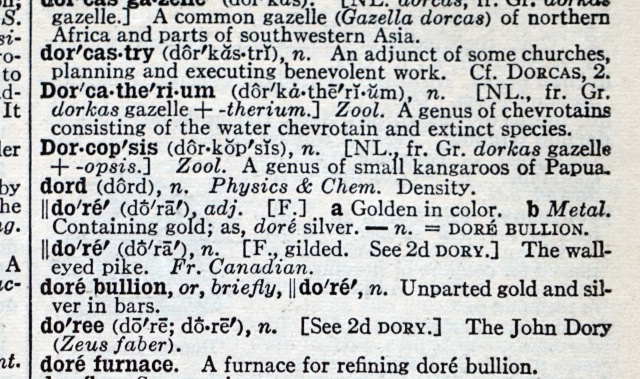
A footnote indicates the excerpt above was based on Philip Gove, "The History of Dord," American Speech, 29 (1954): 136-8.When the guidelines for etymology in Webster’s Third were nearing completion, Gove took time out to add the story of dord to the lore of how things can go wrong in dictionary making. Dord was a word that had appeared spontaneously and had found a quiet niche in the English language two decades earlier. It was recorded in Webster’s Second in 1934 on page 771, where it remained undetected for five years. It disappeared from the dictionary a year later without ever having entered common parlance. The facts, which had been established years earlier through a search of company files, were as follows, as abridged from Gove’s explanation.The lack of an etymology for dord, meaning "density," was noted by an editor on February 28, 1939, when he was perusing the dictionary. Startled by the omission, he went to the files to track down what had happened and what needed to be done. There, he found, first, a three-by-five white slip that had been sent to the company by a consultant in chemistry on July 31, 1931, bearing the notation "D or d, cont/ density." It was intended to be the basis for entering an additional abbreviation at the letter D in the next edition. The notation "cont," short for "continued," was to alert the typist to the fact that there would be several such entries for abbreviations at D.
A change in the organization of the dictionary possibly added to the confusion that followed. For the 1934 edition, all abbreviations were to be assembled in a separate "Abbreviations" section at the back of the book; in the previous edition words and abbreviations appeared together in a single alphabetical listing (which is how they again appeared in the Third Edition.) But after the original slip was typed for editorial handling, it was misdirected. Eventually, it came to be treated with the words rather than with the abbreviations.
Th editorial stylist who received the first typed version should have marked "or" to be set in italics to indicate that the letters were abbreviations (D or d). But instead, she drew a continuous wavy line underneath to signify that "D or d" should be set in boldface in the manner of an entry word, and a label was added, "Physics & Chem." Since entry words were to be typed with a space between letters, the editorial stylist may have inferred that the typist had intended to write d o r d; the mysterious "cont" was ignored. These errors should have been caught when the word was retyped on a different color slip for the printer, but they were not. The stylist who received this version crossed out the "cont" and added the part-of-speech label n for noun.
"As soon as someone else entered the pronunciation," Gove wrote, "dord was given the slap on the back that sent breath into its being. Whether the etymologist ever got a chance to stifle it, there is no evidence. It simply has no etymology. Thereafter, only a proofreader had final opportunity at the word, but as the proof passed under his scrutiny he was at the moment not so alert and suspicious as usual."
The last slip in the file -- added in 1939 -- was marked "plate change imperative/urgent." The entry was deleted, and the space was closed up by lengthening the entry that followed. In 1940 bound books began appearing without the ghost word but with a new abbreviation. In the list of meanings for the abbreviation "D or d" appeared the phrase "density, Physics." Probably too bad, Gove added, "for why shouldn't dord mean density?"
A video by Merriam-Webster on YouTube explains how dord made its way into the dictionary.
Actually, there is a word dord — an ancient trumpet, originating in Ireland [Charles Turner].
ESQUIVALIENCE, defined as "n. the willful avoidance of one’s official responsibilities," is a fabricated word inserted into the 2001 first edition of the New Oxford American Dictionary to protect the copyright of the electronic edition. Erin McKean, the editor-in-chief of the second edition of the dictionary, said, "The editors figured, We’re all working really hard, so let’s put in a word that means ‘working really hard.’ Nothing materialized, so they thought, Let’s do the opposite." An editor named Christine Lindberg came up with the word. A phony entry in the 1975 edition of the New Columbia Encyclopedia is LILLIAN VIRGINIA MOUNTWEAZEL, described as a fountain designer turned photographer who was celebrated for a collection of photographs of rural American mailboxes titled Flags Up! She was born in Bangs, Ohio, in 1942, and died at 31 in an explosion while on assignment for Combustibles magazine. [Information from Charles Turner, referring to a 2005 article in the New Yorker]
Some non-existent places are GOBLU and BEATOSU, which appeared as towns on the 1979-80 Michigan State Highway Commission map; they actually represented Go Blue! and Beat OSU, and were deleted from the 1980-81 map [Dickson]. AGLOE was added to a road map of upstate New York in the 1930s by Otto G. Lindberg and Ernest Alpers, who anagrammed their initials to get the town name. (More information is here.) The non-existent town of ARGLETON in West Lancashire was found on Google maps in 2008 [Charles Turner]. SANDY ISLAND, which is found on Google Earth and other world maps midway between Australia and New Caledonia, was found in 2012 not to exist. See the Wikipedia article Fictitious Entry.
The earliest known use of OMG is in a 1917 correspondence from British Admiral John Arbuthnot Fisher to Winston Churchill, wherein Fisher excitedly relayed the phrase to his former Royal Navy colleague: “I hear that a new order of Knighthood is on the tapis—O.M.G. (Oh! My God!)—Shower it on the Admiralty!!” See this web page.
MS. has been dated to 1901. An earlier use of Ms. is on a 1767 tombstone in Plymouth, Massachusetts: "HERE LIES INTERRD [sic] THE BODY OF MS. SARAH SPOONER." However, it is considered a likely mistake by the engraver of the tombstone. See this article.
MULTIVERSE was used in 1895. See this article.
A 2002 New York Times article points out that John A. Murphy is credited with a 1972 marketing masterstroke with "Lite, a fine Pilsner beer," but that the OED shows a use of leoht beor in about the year 1000.
According to a 2005 column by William Safire, the phrase INTELLIGENT DESIGN appears in an 1847 issue of Scientific American, but it was probably coined in its present sense in Humanism, a 1903 book by Ferdinand Canning Scott Schiller: "It will not be possible to rule out the supposition that the process of evolution may be guided by an intelligent design."
According to Time (July 3, 2006), LUNATIC FRINGE was coined by Theodore Roosevelt in a letter he wrote after losing the 1912 election: "The various admirable movements in which I have been engaged have always developed among their numbers a large lunatic fringe."
Some dictionaries state that J. R. R. Tolkien coined HOBBIT in 1937, but the word has since been found in 1895 in the Denham Tracts.
ANTIBIOTIC was coined in 1860, but in a sense different from its current meaning. Matthew F. Maury (1806-1873), a U. S. Naval officer and founder of the U. S. Naval Observatory, coined the word in his 1860 textbook, Physical Geography of the Sea and its Meteorology. Arguing against the existence of extra-terrestrial life, he declared, “I incline to the antibiotic hypothesis.”
Although the Channel Tunnel linking England and France across the English Channel was not started until 1988 and was completed in 1994, the concept was conceived as early as 1802. In the February 4, 1914 issue of The Sketch, K. Howard declared, “Another word that will be stolen from me ... is ‘Chunnel’. This, naturally, will be the pet name for the Channel Tunnel when we get it.” He was right: in 1957, a writer for the New York Times Magazine claimed his newspaper coined the term. [Taken from this page, which features a list of 10 surprisingly old words.]
UNFRIEND was used as a verb in 1659: “I hope, sir, that we are not mutually un-friended by this difference which hath happened betwixt us.” The word was used as a noun in 1275. [Charles Turner]
According to this article, Jane Austen (1775–1817) used the phrases SHUT UP, DIRT CHEAP, DOG TIRED, DINNER-PARTY, and BRACE YOURSELF. The last two appear in her 1815 novel Emma. She also came up with the phrase, “If I’ve told you once, I’ve told you 100 times.” She is quoted 1,640 times in the latest edition of the OED.
A perhaps surprisingly recent word is SCIENTIST, coined in 1834 by William Whewell.
According to this article, the word MEH, defined as “an expression of indifference or boredom,” has been traced back to a 1992 Melrose Place online forum in which one commenter wrote, “Meh... far too Ken-doll for me....” The term was popularized on The Simpsons. However a word has been found, spelled mem ayin, in a 1928 edition of a Yiddish-English-Hebrew dictionary, where it is given as an interjection defined as “be it as it may.” [Charles Turner]
TWEEN appears in The Lord of the Rings: “At that time Frodo was still in his tweens, as the hobbits called the irresponsible twenties between childhood and coming of age at thirty-three.” [Charles Turner]
SWAG, referring to clothing, is found in 1838 in Oliver Twist: “It's all arranged about bringing off the swag, is it?” [Charles Turner]
The term FACE-BOOK has been found in print in 1902. See this article. In 1594 Shakespeare used WORM-HOLES in his poem “The Rape of Lucrece.”
The OED has a citation of BAD, meaning good, from 1897 [Charles Turner].
TWERK was added to the Oxford English Dictionary in 2015. Research by the OED has found the term was first used in 1820 as a noun spelled twirk, meaning “a twisting jerking movement” or “twitch.” It then emerged as a verb by 1848 and the modern spelling was adopted by 1901.
MATRIX, BUSYBODY, CASTAWAYE, BROKEN HARTED, LONGESUFFERINGE, and STOMBLINGE BLOCKE appear in William Tyndale’s translation of the Bible.
(Tyndale’s translation of the Bible has the earliest known appearances of these words: SCAPEGOAT, PEACEMAKER, INTERCESSION, and PASSOVER. These words have been attributed to Tyndale, although there is some debate: ATONEMENT and MERCY SEAT.)
A Civil War letter written in 1862 was recently found to include the phrase KICK ASS, which may have been used in the modern sense. An article is here.
An article listing surprisingly old words is here.
[Charles Turner contributed to this section]
lighttight and lillypilly are the longest words consisting of only long letters. Some nine-letter words are flightily, highlight, and hillbilly. (However, if hyphens are allowed, highty-tighty (Chambers) and fifty-fifty are longer [Yarlagadda police].)
The original source for these two lists included i as both a short and long letter.
gyp and gyppy (in OSW and OED2) consist only of letters with descenders.
Some words with only "up" letters are tikitiki (W2), libidibi (W2), dikdik, titbit, and tidbit. OED2 also has the obsolete biddikil and tittifill and the variant spelling hiddill.
[Mike Turniansky, Jim Cook, Stuart Kidd, Rex Gooch, and Philip Bennett contributed to the letter-size section].
ETAOIN SHRDLU is defined in W3 as "a combination of letters set by running a finger down the first and then the second left-hand vertical banks of six keys of a Linotype machine to produce a temporary marking slug not intended to appear in the final printing." The word comes from the layout of the keys on a Linotype machine. The letters also correspond exactly to the sequence of most frequently used letters found in English writing. That is, "e" is the most frequently occurring letter, followed by "t," etc., according to one study.
An entire book that does not use the letter e, a novel titled Gadsby, was published in 1939. Some interesting information about the book is here.
Inspired by that book, Yarlagadda Police wrote a short play titled Man, God and the Eco which consists entirely of three-letter words. According to the author, the play consists of 3456 words, or 789 uniquely-appearing words.
Some long words consisting of only letters in the second half of the alphabet are NONSUPPORTS, PUTTYROOTS, POPPYWORTS, SYNSPOROUS, NONTORTUOUS, SOUPSPOONS, PROSUPPORT, and ZOOSPOROUS [Marc Broering, Stuart Kidd, Philip C. Bennett, Paul Wright]. Allowing proper names, there are TUTTOQQORTOOQ (13 letters, an island in Greenland) and ROSSOUWSPOORT (13 letters, the name of a pass in South Africa) [Susan Thorpe].
A group of researchers from Britain’s University of Warwick surveyed 800 people to find the funniest words in English. Their list: BOOTY, TIT, BOOBY, HOOTER, NITWIT, TWIT, WADDLE, TINKLE, BEBOP, EGGHEAD, ASS, TWERP. More information is here. [Charles Turner]